Why is my word not accepted in Plate Play?
A familiar word still has to fit the plate and its word list. Here’s how to tell a missing tile from a dictionary rejection—and why neither uses your turn.
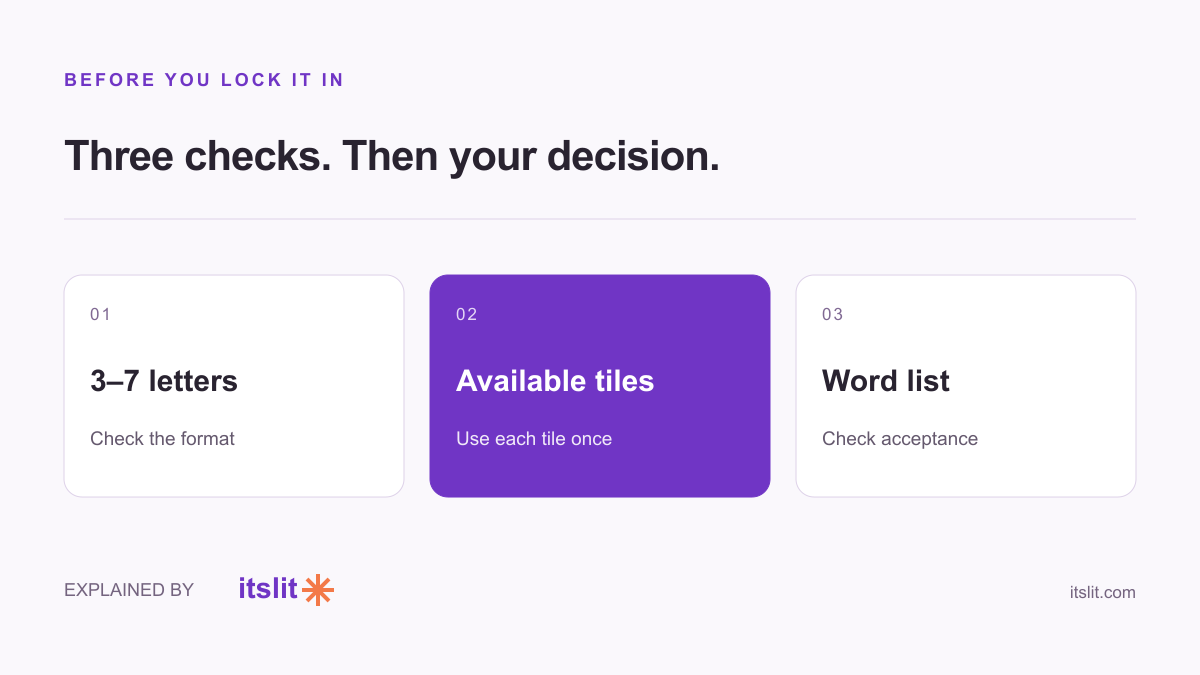
Plate Play checks three things before offering to lock in your answer: the entry must contain three to seven letters, it must fit the available tiles, and it must appear in the game’s fixed English word list. A word you recognize can fail one of those checks. Rejection does not use your final answer.
Check the tiles, including repeated letters
You can rearrange letters freely, but you cannot create an extra tile. If a plate contains just one E, a word needing two Es does not fit. If it contains two, you may use both. Think of the plate as seven physical pieces rather than a list of letter types.
Here is an invented practice example: a rack with C, A, T, E, R, S and O has the pieces for CAT. It does not have the pieces for TREE, which needs a second E. That tells you nothing about whether TREE is an English word; it only tells you that this example rack cannot spell it.
The dictionary is a separate check
Passing the tile check is not enough. The game then compares your word with its fixed list. That list is based on the linked open-source word-list project, but the actual game’s stored dictionary determines acceptance.
The rules describe an English word game with many inflections and regional spellings, not an exhaustive record of everything people say. Do not assume a word is allowed because another game accepts it. Equally, an unfamiliar accepted entry is not evidence that the game uses only common everyday vocabulary.
The entry field accepts letters, not spaces, hyphens or punctuation. Use the game’s feedback to distinguish a format or tile problem from a word-list problem. If the message says the word is not in the list, rearranging the same spelling will not change that result.
A failed connection is not a rejected word
Checking requires a response from the game’s server. If the connection fails, the interface asks you to try again; that does not establish whether your candidate is in the dictionary. Wait for an accepted result before treating the displayed point preview as an eligible score.
Even then, checking is not the final step. An accepted word opens a confirmation. You can keep thinking, or choose to lock it in. This distinction lets you explore a candidate without accidentally ending the round.
A useful way to troubleshoot
- Count the letters: three to seven.
- Match each letter to a separate tile, paying attention to repeats.
- Read the response: tile mismatch, word-list rejection or connection issue.
- If accepted, decide whether this is your final word before confirming.
For scoring and the daily reset, see the complete Plate Play guide. Or return to the plate with a fresh set of eyes.
Sources
What remains uncertain
The game uses a fixed dictionary, so acceptance is not a judgment about every dialect or specialist vocabulary. This guide describes the implementation on September 26, 2026; future dictionary updates may change accepted entries.
How this story was prepared
AI-assisted guide prepared from the current itslit implementation and linked game rules, checked September 26, 2026; not independently human-reviewed. Scoring examples are illustrative, not today’s solution.