How should sports reporters disclose conflicts of interest?
A practical guide to disclosure, reassignment and the difference between ethical standards and a finding about a specific story.
A useful starting point
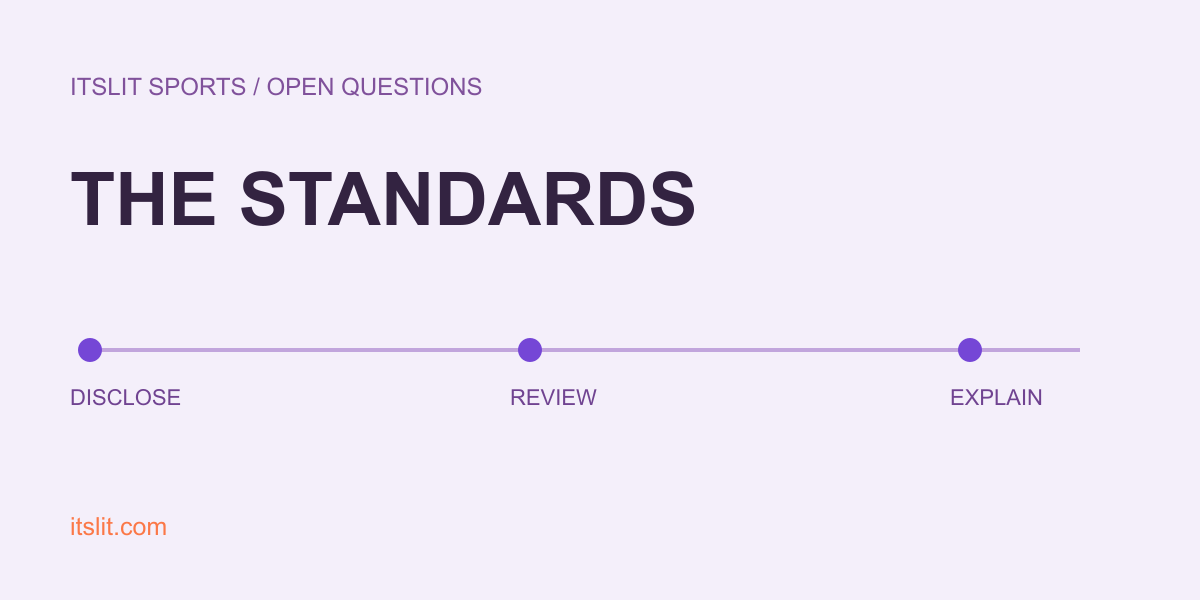
The Society of Professional Journalists’ ethics code calls for avoiding real or perceived conflicts and disclosing unavoidable ones. It also emphasizes independence and accountability. The code is professional guidance, not a finding about this case or a substitute for an employer’s own rules.
Disclosure is information for the audience
A reader cannot weigh a relevant connection that has been concealed from view. A useful disclosure identifies the connection plainly enough to understand why it may matter. It should sit where the relevant work is encountered, rather than require readers to reconstruct it from unrelated posts.
Disclosure is not automatically a complete remedy. In a hypothetical newsroom, an editor might decide that a conflict requires reassignment or an additional review. That example describes an editorial option, not a claim that a particular action occurred at The Athletic, ESPN or another organization.
Accuracy and independence need separate checks
One check asks whether a sentence is supported. Another asks whether the reporting process has been appropriately insulated from competing interests. A factual correction addresses an identified error; a disclosure addresses relevant context. Neither should be used as a catch-all label for the other.
The Russini series separates these questions deliberately. Our review explainer attributes the employer’s reported findings. Our ballot tracker asks about a different institution’s rules. Applying a newsroom code to an awards panel without checking that panel’s actual requirements would confuse two systems.
What to look for in a policy
As a reader, look for who must disclose, what relationships fall within the policy, who reviews them, and what happens when circumstances change. Ask whether the policy distinguishes an apparent conflict from established misconduct, and whether its remedies are explained.
These are analytical tools for evaluating a published policy. They are not evidence that any named institution has failed to adopt one. Our outstanding requests seek documents and explanations before drawing those conclusions.
Explore the full Russini–Vrabel series or the question tracker.
Sources
What remains uncertain
No original interviews or internal records were obtained. The article distinguishes dated reporting from analysis; it does not establish motives or misconduct.
How this story was prepared
AI-assisted explainer using linked sources, checked September 27, 2026; not independently human-reviewed. No outreach was sent.