What causes the seasons? Earth’s tilt explains the switch
Earth’s tilted axis changes the angle and duration of sunlight through the year. Being closer to the Sun does not explain why the hemispheres have opposite seasons.
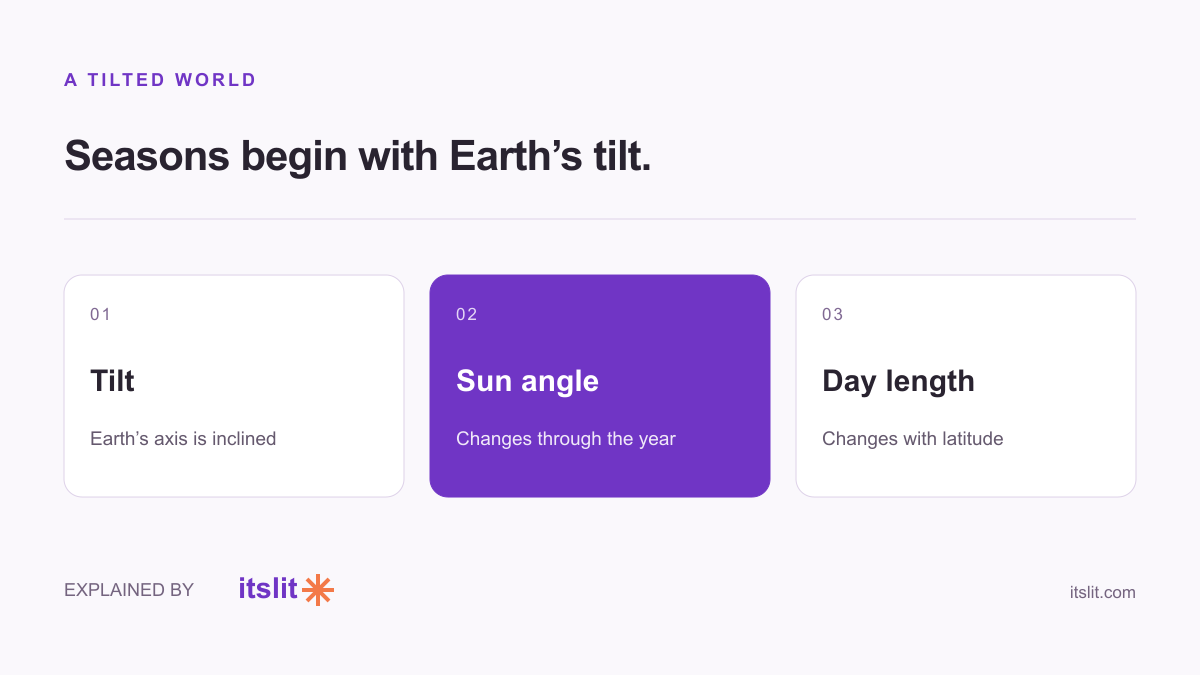
Earth's seasons result from its tilted axis as it travels around the Sun. The tilt changes which hemisphere receives more direct sunlight and longer daylight. NASA's seasons guide explains why the familiar “closer means summer” idea misses the main cause.
Sunlight arrives at a changing angle
Over a year, Earth's axis keeps pointing in approximately the same direction while Earth moves around its orbit. Around June, the Northern Hemisphere tilts toward the Sun; around December, the Southern Hemisphere does.
That changes the angle at which sunlight reaches the surface. The important comparison is the orientation of a hemisphere toward the incoming light, not simply Earth's overall distance from the Sun.
Day length changes too
NOAA's satellite-service explanation connects the tilt with the annual solstices. A hemisphere's summer solstice has its longest daylight period, and its winter solstice has its shortest. June and December put the two hemispheres in opposite seasonal positions.
This provides a useful check on an explanation: it must account for summer in one hemisphere while the other has winter. A statement about the whole planet moving closer to the Sun cannot do that on its own.
Earth's distance does change—but it isn't the switch
Earth's orbit is not perfectly circular. NASA notes that Earth is closest to the Sun around January and farthest around July. For the Northern Hemisphere, those are winter and summer respectively—the reverse of what the simple distance story would predict.
Distance is a real orbital property. Treating it as the main explanation for ordinary seasons is the mistake.
Why do some calendars start a season on a different date?
There are also two common ways of organizing the calendar. NOAA NCEI distinguishes astronomical seasons, marked by equinoxes and solstices, from meteorological seasons, grouped by the annual temperature cycle into calendar months.
For example, Northern Hemisphere meteorological summer groups June, July, and August. An astronomical calendar begins summer at the June solstice. The different boundaries serve different purposes; they don't represent competing explanations of Earth's tilt.
When someone names the first day of a season, ask which calendar—and which hemisphere—they mean.
Keep exploring: Why the sky looks blue · Why sunset colors change.
Sources
- NASA Space Place: what causes seasons
- NOAA NESDIS: changing seasons and solstices
- NOAA NCEI: meteorological and astronomical seasons
What remains uncertain
This explains the broad astronomical mechanism and common calendar definitions, not the weather on a particular day. Local seasonal patterns vary.
How this story was prepared
AI-assisted article prepared using the linked sources; not independently human-reviewed. Suggested observations and illustrative examples are explanations, not experiments conducted by itslit.