How can you check whether an AI citation is real?
A convincing reference is only the beginning. Check that the source exists, matches the citation, and actually supports the claim.
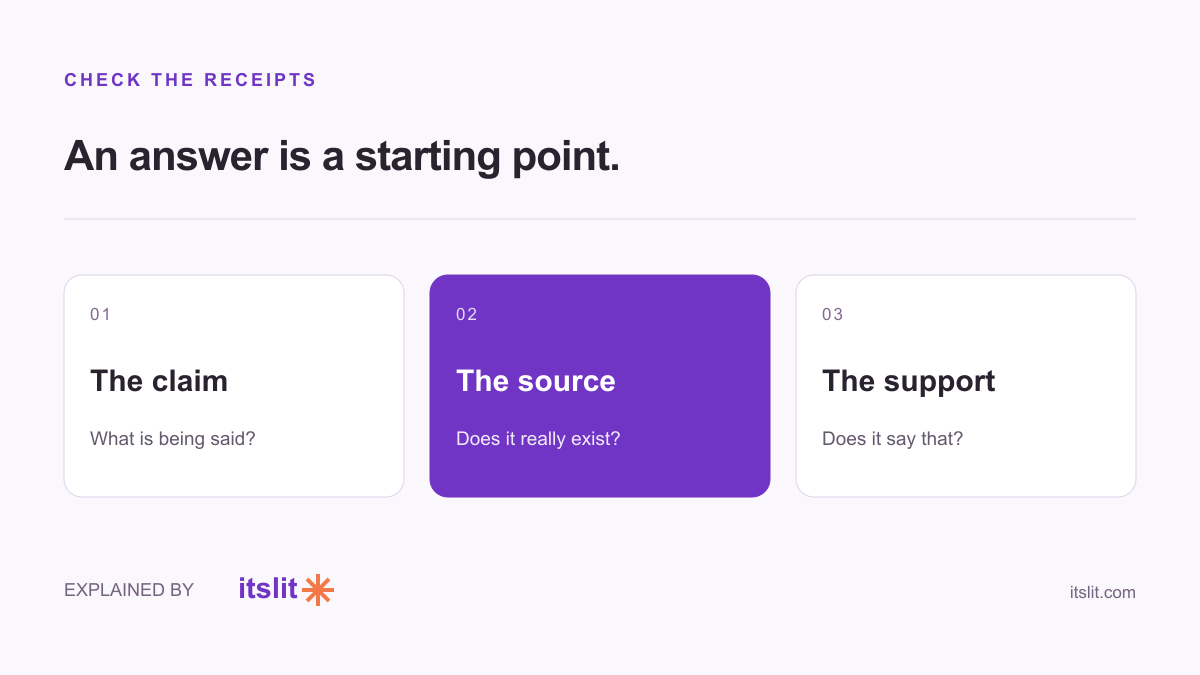
To check an AI citation, open the original source, match its identifying details, and find the passage supporting the claim. Those are three different checks. A working link alone does not settle the question.
Start with the claim, not the footnote
Copy the exact sentence you want to verify. Is it asserting a date, a quotation, a percentage, or a cause-and-effect relationship? This makes the task smaller than deciding whether an entire answer is trustworthy.
OpenAI explicitly warns that ChatGPT can invent references and produce inaccurate information in its guide to factual accuracy. Treat a citation as a route to evidence, rather than evidence you have already inspected.
Check that you found the right document
Open the link and compare the title, author, publication and date with the reference. If it leads to a homepage or an error, search for the title independently. A broken link does not prove a source was invented; it means the source remains unresolved.
For scholarly work, Crossref Metadata Search accepts titles, authors, DOIs and full citations. Use it to look for a matching record, then follow through to the publication. A missing Crossref result is not definitive proof that a work does not exist.
Read the surrounding passage
Use the page's find function for the important term or number, then read the surrounding paragraphs. Check who or what was studied, the timeframe, and any qualifications. Does the source report the result itself, or merely quote somebody else's assertion?
Here is a hypothetical mismatch: an answer says a tool saves every worker two hours each day, while the linked study describes a small group's self-reported weekly savings. The document could be real and relevant while failing to support that sentence.
If the full text is unavailable, record that limit. Do not treat an abstract as proof of details it does not contain.
Keep a tiny evidence log
For anything you plan to publish, save four things: the claim, its source URL, the supporting passage or section, and the date checked. Mark unresolved claims clearly instead of quietly carrying them forward.
You can ask an AI to organize this log, but repeat requests for reassurance are not a substitute for opening the source. If the evidence supports a narrower statement, rewrite the statement. That small edit is often where the real work happens.
Keep exploring: Why confidence is not evidence.
Sources
What remains uncertain
This is a practical checking workflow, not proof that any particular answer is correct. Some sources are inaccessible or absent from a given index.
How this story was prepared
AI-assisted article prepared using the linked sources, checked on September 26, 2026; not independently human-reviewed.